
A pioneer of the energy transition in Europe, Denmark has relied on wind power for several decades, and more recently on solar power, to decarbonise its energy mix. At the same time, the electrification of transport, heating and many other uses is progressing rapidly.
This transformation is creating a major challenge: integrating an increasing share of renewable energy while maintaining the stability of the electricity grid. Against this backdrop, EDF power solutions Denmark has successfully diversified its activities to support the changing needs of the market.
From Citelum to EDF power solutions Denmark
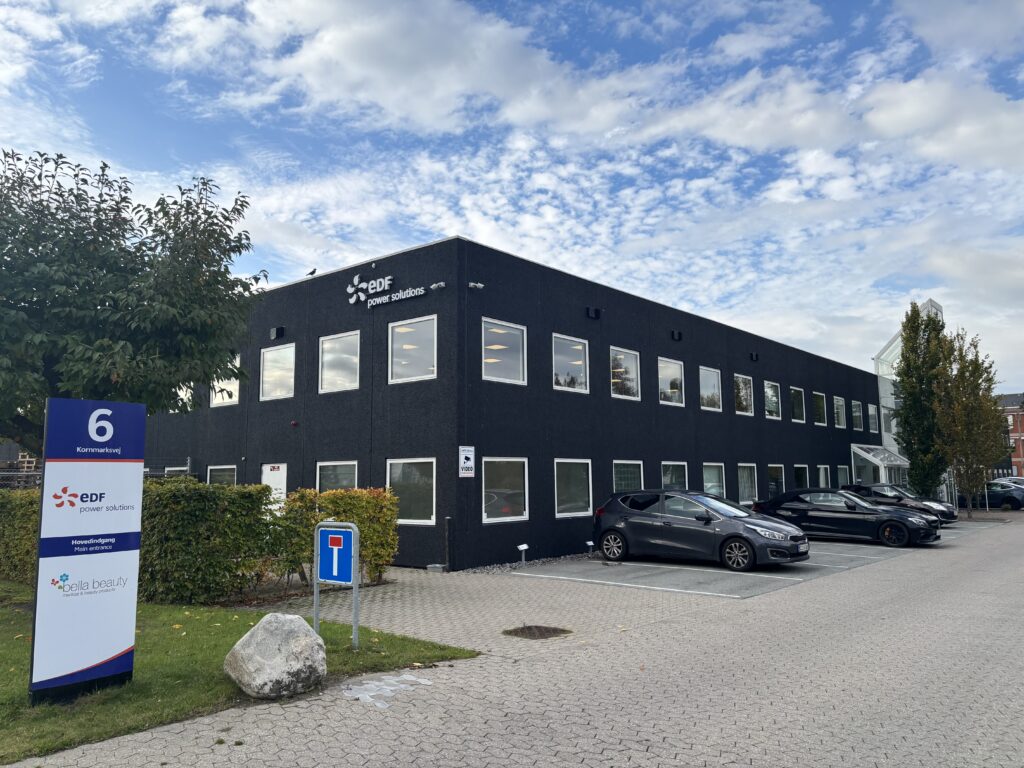
Present in Denmark since 2013, the subsidiary now has 90 employees, almost half of whom work in the field. Based in a new headquarters since 2026, the teams support local authorities and businesses in their decarbonisation projects.
Initially established as Citelum to develop and operate Copenhagen’s public lighting network, the subsidiary became EDF Denmark in 2022, then EDF power solutions Denmark in 2025. This evolution reflects the progressive expansion of its activities.
Public lighting: the subsidiary’s historical activity
The contract awarded in Copenhagen in 2013 marked the beginning of the subsidiary’s operations in Denmark. Thirteen years later, the activity has grown significantly: the teams now maintain and operate nearly 137,000 light points across 11 municipalities, including 5,000 new light points added in 2026.
Over the years, the expectations of Danish local authorities have also evolved. Following the modernisation of infrastructure through LED lighting and smart control systems, reducing the environmental impact of public lighting is now playing an increasingly important role in projects.
In several municipalities, sensors enable streetlights to reduce their intensity when no activity is detected. New LED technologies also make it possible to adjust the wavelength and colour of the light to limit its impact on insects and wildlife.
This approach combines energy performance, quality of service and environmental protection.
Charging infrastructure: supporting the growth of electric mobility
The rapid growth of electric vehicles in Denmark has opened up new opportunities for EDF power solutions Denmark. Launched four years ago, the charging activity is a natural extension of its mission: supporting the increasing electrification of everyday uses and contributing to the decarbonisation of transport.
In just a few years, the teams have contributed to the deployment of a network of nearly 2,000 public charging points across the country.
Today, the activity increasingly focuses on the practical needs of businesses and EV users, including electric vehicle fleets, supermarket car parks, office buildings and other locations with a regular flow of drivers.
Focus on the partnership with Green Mobility
Signed in August 2026, the partnership between EDF power solutions Denmark and Green Mobility supports the development of electric car sharing in the Copenhagen region.
As part of the partnership, EDF power solutions is deploying 200 charging points across 51 sites dedicated to Green Mobility’s fleet of 1,500 electric vehicles.
To date, 20 sites are already operational, and more than 600,000 kWh have been delivered through EDF power solutions’ charging network in 2026.
As the electrification of transport accelerates, another issue is becoming increasingly strategic: how can electricity generated largely from renewable sources be managed and stored effectively?
Battery storage: the next step in diversification
Denmark’s electricity system relies heavily on renewable energy, particularly wind and solar power. In this context, flexibility plays a key role in maintaining the balance between electricity generation and consumption.
To address this challenge, EDF power solutions Denmark has taken another step in its diversification with the creation, in December 2025, of a joint venture with BattMan Energy dedicated to battery energy storage.
Together, the partners are currently developing four projects representing a total capacity of 180 MW and 520 MWh of energy storage.
Construction of these projects is now underway, with the first sites expected to be commissioned in 2027.
Beyond the technology itself, this new activity marks an important evolution for the subsidiary. After supporting electricity use through public lighting and then electric mobility, EDF power solutions Denmark is now contributing to the flexibility of the electricity system itself.
Local expertise backed by an international network
This diversification builds both on the subsidiary’s in-depth knowledge of the Danish market, developed over more than a decade, and on the expertise available across EDF power solutions internationally.
To develop new activities, particularly in battery storage, the Danish teams can draw on the experience and expertise developed in other countries.
This ability to combine strong local roots with international experience is a key asset in supporting the transformation of Denmark’s energy sector.
From public lighting to battery storage and electric mobility, the journey of EDF power solutions Denmark illustrates how a subsidiary can continuously develop its expertise to meet the emerging needs of a rapidly changing market.
What’s next?
“Our ambition is clear: to continue strengthening our position in Denmark in our historical activities of public lighting and electric vehicle charging, while opening a new chapter with battery storage. Our strong local presence, our knowledge of the Danish market and the support of a major international group such as EDF give us solid foundations to achieve this ambition.”
Henrik Rasmussen, CEO of EDF power solutions Denmark