
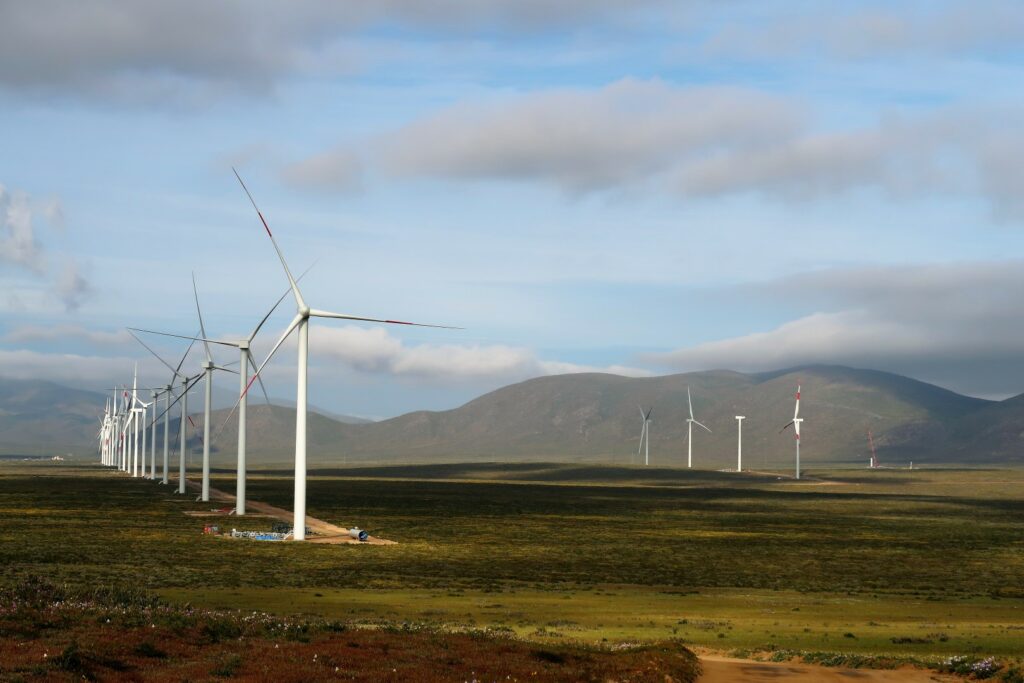
Between the Pacific Ocean and the Andes Mountains, Chile benefits from exceptional natural conditions for renewable energy. In the north, the Atacama Desert has some of the highest levels of solar irradiation in the world. Further south, steady winds offer significant potential for wind power.
Present in the country since 2014, EDF power solutions has been supporting the transformation of Chile’s electricity system through solar, wind, thermal and energy storage projects. This experience places the company at the heart of one of Latin America’s pioneers in the energy transition, which now faces a new challenge: integrating increasing amounts of renewable energy while ensuring grid flexibility and security.
Vast renewable energy potential
Chile has set ambitious targets: to meet 80% of its electricity demand with renewable energy by 2030, gradually phase out coal by 2040 and achieve carbon neutrality by 2050.
Today, nearly 70% of the country’s installed power generation capacity already comes from renewable sources, mainly solar and wind.
This momentum is also helping to meet the significant energy needs of the mining industry. As the world’s leading copper producer and a major lithium player, Chile supplies raw materials that are essential to electrification and low-carbon technologies.
However, the rapid development of renewable energy is bringing new challenges. A large share of solar power generation is located in the north of the country, far from the main consumption centres. As electricity grid capacity does not always expand at the same pace, some of the available renewable electricity cannot always be fed into the grid.
Storage: the next stage of Chile’s energy transition
To make better use of its renewable energy production, Chile is rapidly developing battery energy storage systems (BESS). In less than four years, around 3.5 GW of storage capacity has been deployed.
These systems make it possible to store electricity when renewable generation is abundant and release it when demand on the grid increases. They are therefore becoming an essential component of the flexibility of Chile’s electricity system.
This shift marks a new stage in the transition: the challenge is no longer simply to produce more renewable electricity, but to integrate it more effectively into the power system.
EDF power solutions, a major player in Chile
Present in Chile since 2014, EDF power solutions is now one of the country’s five leading electricity producers. More than 90 employees work within the local subsidiary, which operates nearly 1.7 GW of gross installed capacity through its main platforms, Generadora Metropolitana and Cabo Leones I.
Its portfolio combines renewable energy with dispatchable generation capacity to support the needs of Chile’s electricity system.
One of its flagship projects is CEME 1, which became Chile’s largest solar power plant in 2024. Located in the Atacama Desert, it consists of 882,000 photovoltaic panels with an installed capacity of 480 MW. It can generate the equivalent of the electricity consumption of around 400,000 households and avoid nearly 330,000 tonnes of CO₂ emissions each year.
In the same region, the Cabo Leones I wind farm comprises 67 wind turbines with an installed capacity of 175 MW. Its output is equivalent to the electricity consumption of around 163,000 households and helps avoid nearly 145,000 tonnes of CO₂ emissions every year.
In addition, the Nueva Renca and Los Guindos thermal power plants provide dispatchable capacity that currently contributes to security of supply and grid stability.
Towards large-scale hybrid projects
To go one step further, EDF power solutions is now developing projects that combine renewable energy generation with storage.
DUNE PLUS was notably designed to supply the power purchase agreement awarded by CODELCO, Chile’s state-owned mining company.
Further south, WAYRA is planned as a 557 MW energy complex combining solar and wind power with an energy storage system of around 750 MWh.
This combination of renewable energy and storage illustrates the new direction of the Chilean market: generating low-carbon electricity while also being able to store it and deliver it when the power system needs it most.
As Joan Leal, CEO of EDF power solutions Chile, points out, integrating renewable generation and storage has become a key driver in strengthening the flexibility of the electricity system and helping customers reduce their carbon footprint.
A transition with valuable lessons
Chile’s experience shows that the energy transition is not simply about installing new renewable generation capacity. Grids, storage, flexibility and security of supply must all progress together.
With its exceptional solar and wind potential, the rapid growth of energy storage and the significant energy needs of its economy, Chile is now entering a new stage of its transition.
A transformation whose lessons extend far beyond its borders.